
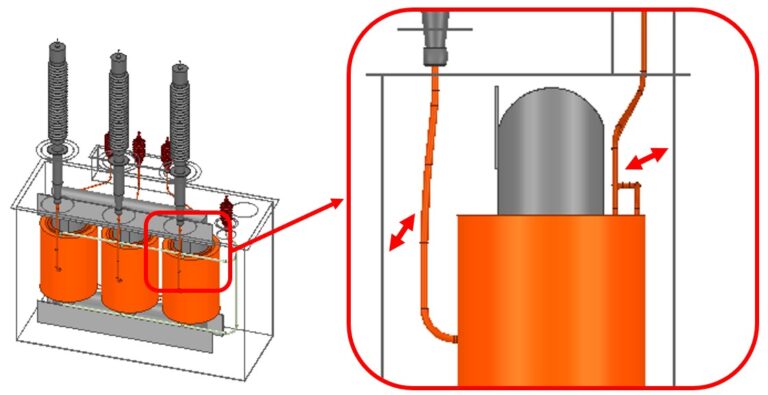
Developing projects with a better cost-benefit ratio is always on the agenda of engineering meetings at transformer manufacturing and refurbishing companies. The goal is always to maintain an adequate safety margin and achieve objectives such as: reducing raw material usage, decreasing distances, reducing weight, reducing external dimensions, among other terms typical of this approach.
But the big question is: how to achieve this goal without compromising the operational safety margin of the transformers?
This challenge can be overcome by using appropriate design analysis tools, such as numerical simulation software based on the finite element method.
Optimizing designs to increase competitiveness is a constant concern for transformer manufacturers.
This article was written to demonstrate the applicability of this simulation tool in determining the appropriate internal insulation distance between the live component, connecting cables, and the transformer tank.
During the transformer design phase, any reduction in the distance between the active part and the equipment tank by millimeters can represent a significant reduction in the amount of raw materials (insulating oil, structural steel, sealing and fastening materials). Furthermore, it is important to emphasize that design optimization and the consequent reduction in the final weight of the equipment are also very important, especially when dealing with large equipment (very complex transport logistics) or equipment located on platforms with regulated weight limitations (as in the case of transformers designed for operation in mobile substations).
In general, in power transformers, the internal distance between the powered elements (windings and connecting cables) and the tank is defined by the voltage class of the equipment. Usually, for the dielectric dimensioning of these points, transformer manufacturers used empirical data and tables with minimum insulation distances based on the manufacturer’s experience.
However, this empirical data becomes obsolete as the voltage of the equipment reaches higher levels. Therefore, simply using a greater distance between the potential points is not sufficient to guarantee an adequate safety margin. This is due to the non-linear behavior of the dielectric withstand capability of the transformer’s insulating fluid in relation to the insulation distance used.
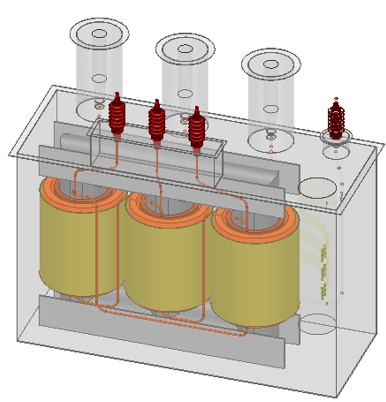
This is where finite element-based numerical simulation tools come in. With these tools, it’s possible to map the electric field in this region of the transformer and define, based on an analysis methodology such as the Cumulative Stress method, the maximum withstandable electric field and the corresponding safety margin. From this methodology, it’s possible to alter the distances and insulation configurations until an adequate spacing condition is obtained between the active part, connecting cables, and the transformer tank. This same methodology for analyzing and calculating the safety margin can also be used internally within the transformer windings.
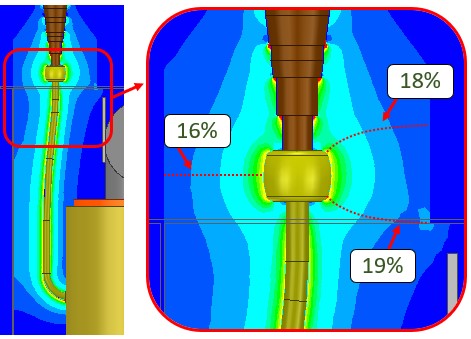

A much more comprehensive approach to this methodology, including references on the subject, is presented by Odirlan Iaronka in his Master’s thesis, which is available in full at this link.
An additional comment on this topic is that this approach can very likely explain why some old transformers that return to the factory for evaluation or refurbishment exhibit large distances between the connecting cables and the tank. This characteristic may originate, among other reasons related to the quality of materials and manufacturing processes, from the oversizing of insulation distances, which were defined before the advent of current design tools. In fact, it is usually possible to increase the original power of the transformer in refurbishment processes without modifying the tank size simply by using current technical concepts and design tools aligned with the evolution of materials and manufacturing processes.
FUN FACT: Some equipment with voltage classes higher than 230kV has so much space between the active part and the tank that a relatively small person can walk inside without much difficulty (this feature certainly made internal inspections easier, didn’t it?! hahaha).