
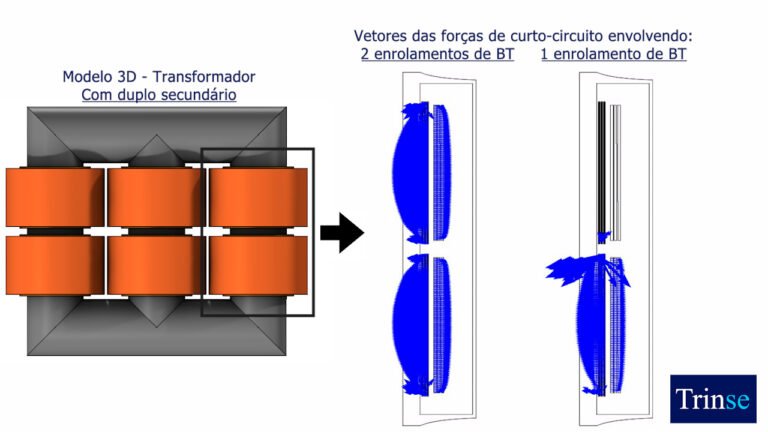
There are applications where the use of transformers with multiple secondary windings is adopted for various reasons, ranging from reducing the nominal current of the low voltage (limitation of circuit breakers or protection system) to increasing the available configurations for connecting the circuits involved (connection of multiple inverters in the case of renewable generation or lower power sub-circuits in the case of the power system).
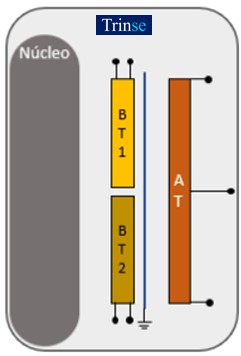
In these cases, the connection commonly used in transformers with multiple secondaries is based on dividing the high-voltage winding into parts that operate in parallel, magnetically coupled with each of the low-voltage windings, as can be seen in the figure on the side.
Considering this constructive characteristic, it is important to take into account in the equipment design and in the parameterization of the protection systems that short circuits in only one of the low-voltage windings can occur, generating an asymmetrical condition of the distribution of the magnetic field and the resulting forces internally to the transformer.
In fact, it is more common for short circuits to occur in only one of the windings, since it is unlikely that a typical operating event will be able to simultaneously involve both low-voltage windings in a short-circuit condition.
The next figure (left image) shows the distribution of magnetic induction [T] and force vectors of a symmetrical short circuit involving the 2 low-voltage windings. The same figure (right image) shows the distribution of magnetic induction [T] and force vectors of an asymmetrical short circuit involving only 1 of the low-voltage windings.
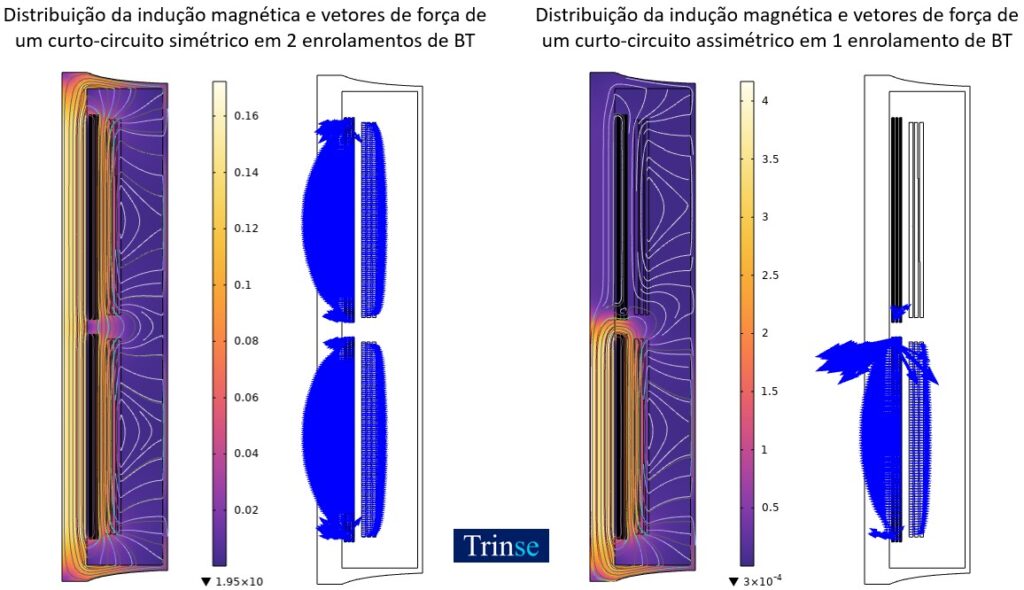
The next figure (left image) shows the distribution of magnetic induction [T] and force vectors of a symmetrical short circuit involving the 2 low-voltage windings. The same figure (right image) shows the distribution of magnetic induction [T] and force vectors of an asymmetrical short circuit involving only 1 of the low-voltage windings.
A short-circuit event in a single low-voltage winding of transformers with multiple secondaries can create the false impression that it is a low-intensity event when observed by protection and measurement systems installed on the high-voltage side.
This effect occurs because when a short circuit happens in only one of the low-voltage windings, the amplitude of the current flowing from the high-voltage side to “feed” this event is practically half the maximum short-circuit current predicted for the high-voltage winding in the equipment design (and usually included in the nameplate data).
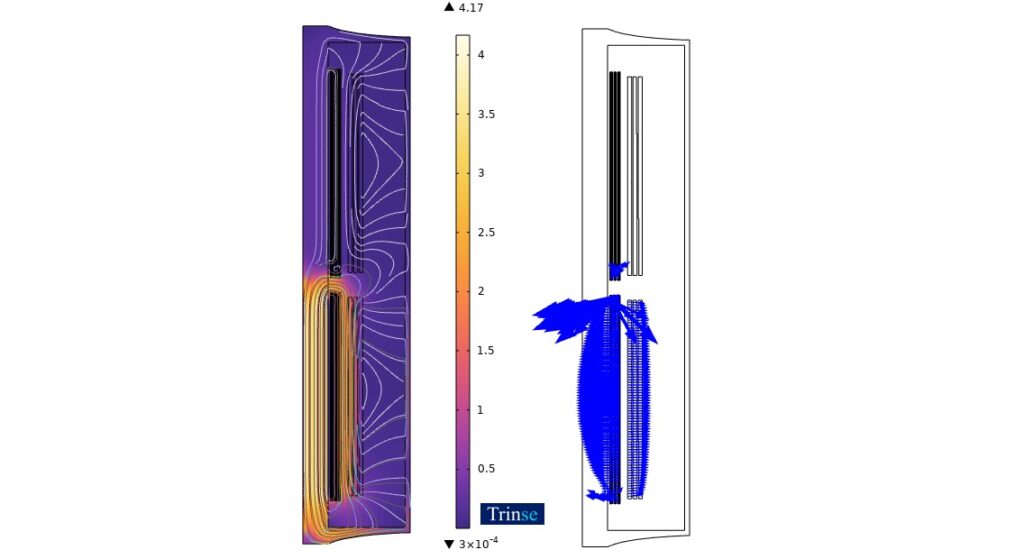
This occurs because, ideally, only the half of the high-voltage winding that was directly involved in the short circuit has the current flowing from the event (ignoring any minor mutual coupling). The other half of the high-voltage winding, due to the parallel connection effect, is practically unaffected by the event and does not exhibit significant current flow, as can be seen in more detail in the figure below.
Obviously, this maximum current value on the high-voltage side is an estimate because, in practice, calculating the correct amplitude depends on the transformer’s construction parameters, voltage level, and the system and short-circuit impedances involved.
Therefore, even if the current measured on the high-voltage side is less than the maximum amplitude supported by the equipment, the effects that occur in the windings inside the transformer are as, or more, critical than a full short circuit involving both secondaries.
The video below shows the simulation results of the forces generated by a symmetrical short circuit in the two low-voltage windings (left) and, at the same time, shows the effects of the forces generated when a single low-voltage winding is involved (right).
Analyzing the video in more detail, it’s possible to see that the vectors shown have amplitudes at similar levels. However, the asymmetrical magnetic field generated in a short circuit in a single low-voltage winding can generate forces with greater amplitudes at specific points in the winding, as in the hypothetical example in this video, in the central part of the analyzed assembly.
It is important that both manufacturers and end customers of transformers with multiple secondary windings consider the characteristics of short-circuit occurrences in a single low-voltage winding during the design phase and when defining the protection parameters for this equipment.
The manufacturer needs to consider the asymmetrical effects of short-circuit stresses on a single low-voltage winding to determine the correct safety margin of the design from the point of view of withstand capability to these intrinsic system operating events. End customers, in turn, need to be aware of this operating characteristic of transformers with multiple secondaries so that the protection of this equipment is adequately parameterized.
Furthermore, it is important to consider the behavioral characteristics of transformers when exposed to short circuits on a single low-voltage winding, as discussed in this report, when definitive failures occur that culminate in the transformer being taken out of operation, mainly for the process of analysis and determination of the root cause.